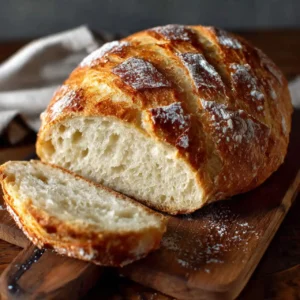
Sourdough Bread
This Sourdough Bread is beautifully crusty on the outside with a soft, chewy, tangy interior that only true sourdough can offer. Slowly fermented for rich flavor and a naturally airy crumb, it’s the kind of loaf that feels artisan and homemade at the same time. Perfect for sandwiches, soups, or simply warm with butter. A timeless, rustic bread that brings bakery-quality goodness to your kitchen.
Ingredients
- 100 g active sourdough starter about 1/2 cup
- 375 g warm water about 1 1/2 cups + 1 tbsp
- 500 g bread flour about 4 cups
- 10 g salt about 1 1/2 tsp
Optional:
- Replace 50–100 g flour with whole wheat.
- Use rice flour to dust your proofing basket.
Instructions
1. Mix the Dough
- Stir the starter into warm water until cloudy. Add flour. Mix until no dry flour remains. Cover and rest 30 minutes. This rest helps the dough hydrate and stretch more easily.
2. Add Salt
- Sprinkle salt over the dough. Pinch and fold it in. Once the salt disappears into the dough, cover again.
3. Bulk Fermentation
- Let the dough rise until puffy. At warm room temperature, this takes 4–6 hours. At cooler temperature, it can take 6–8 hours. You’re looking for a 50–70% rise, not a full double.
Stretch and Folds
- Do 3 sets of stretch-and-folds during the first 90 minutes:
- Set 1: 30 minutes after adding salt
- Set 2: 30 minutes later
- Set 3: 30 minutes later
- Lift one side, stretch up, fold over the center, then rotate the bowl and repeat. These gentle pulls help build strength.
4. Pre-Shape
- Turn the dough onto a lightly floured surface. Pull the edges toward the center to make a loose ball. Flip seam-side down. Rest 15–20 minutes.
5. Final Shape
- Flip seam side up. Pull each edge toward the center again. Flip seam-side down. Use your hands to pull the dough toward you while rotating. This creates surface tension. A tight surface gives a better rise and a more open crumb.
6. Proof
- Place the dough seam side up in a floured basket.
- You have two options:
Overnight Cold Proof
- Refrigerate 12–18 hours. This makes the crust darker and the flavor deeper.
Same Day Proof
- Leave at room temperature 1–2 hours until slightly puffy.
Baking Methods
- You can bake this loaf in a Dutch oven or on a baking steel. Both methods use steam to let the bread expand before the crust sets.
Method 1: Dutch Oven
- Heat the Dutch oven at 475°F for 45 minutes.
- Flip the dough onto parchment. Score the top with a sharp blade. Carefully lower the dough into the pot.
- Bake:
- 30 minutes covered
- 12–18 minutes uncovered
- Cool at least one hour.
Method 2: Baking Steel or Stone
- Heat the steel at 500°F for 45–60 minutes.
- Place an empty metal pan on the bottom rack.
- Flip dough onto parchment. Score the top. Slide the dough onto the steel. Pour 1 cup hot water into the bottom pan.
- Bake:
- 20 minutes with steam at 500°F
- Remove steam pan
- Reduce to 450°F
- Bake 15–20 minutes more
- Let cool one hour.
Video
Notes
📝 Notes
- Use an active, bubbly starter for best rise and flavor.
- Weigh ingredients for consistent results—use a kitchen scale.
- Perform stretch-and-folds during bulk fermentation to build strength.
- Cold retard in the fridge overnight to develop deeper flavor.
- Score the loaf just before baking to control oven spring.
- Bake in a preheated Dutch oven for a crisp, golden crust.
- Cool completely on a rack before slicing to set the crumb.
- Store at room temperature in a paper bag or cloth to retain crustiness.
🍽️ Nutrition Facts (Per Serving)
Calories: 220 kcal;Carbohydrates: 43 g;
Fiber: 2 g;
Sugars: 1 g;
Protein: 7 g;
Fat: 1.5 g;
Saturated Fat: 0.2 g;
Cholesterol: 0 mg;
Sodium: 220 mg;
Potassium: 80 mg;
Calcium: 20 mg;
Iron: 2 mg.